


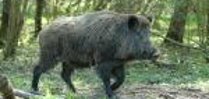
The wild boar is one of the most frequently hunted animals in Central Europe. It is the wild ancestor of our domestic pig.
Strong boars can reach a weight of 200 kg. Animals of this size therefore have a high nutritional requirement. Wild boar are also omnivores. They feed on field crops and break up damp meadows in search of moles, mice, earthworms or insect larvae. In the forest, burrowing has a certain benefit. Larvae of forest pests, snails and the carrion of dead large and small animals are eaten. In addition to the food already mentioned, the wild boar also eats acorns, beechnuts and mushrooms. In the case of large mouse infestations, the wild boar have proven to be extremely useful: in addition to old mice, they also eat young mice.
Wild boars come to towns and cities when their food supply in the forest or fields becomes scarce. Our gardens with compost and leaf piles, as well as waste bins that are not properly secured, are lucrative sources of food for wild boars. The animals are often deliberately fed by humans. As a result, isolated packs have preferred to leave the forest and live in residential areas where hunting is not permitted.
In addition to its immense food requirements, the wild boar has a relatively high reproduction rate. Living together in family groups, consisting of bucks, young boars and overrunners, also contributes to their high localised food requirements. Boars live as solitary animals. The mating season for wild boar is from November to December. One female can give birth to 4-12 young boars.
Under favourable conditions, a wild boar population can increase by up to 200% in the course of a year. Feeding wild boar is prohibited under the Brandenburg State Hunting Act and can therefore be penalised with a fine. Compost heaps and rubbish bins should be secured as a matter of priority in areas populated by wild boar and should not be placed outside your own property!
Those affected should also inform themselves about the behaviour of wild boar, e.g. about wild boar leading young pigs. They should be kept out of the way as they tend to defend their offspring. In case of doubt, the game can only be prevented from entering a property by a truly game-proof fence.
Due to the high wild boar population in the municipality of Rüdersdorf, the responsible hunters receive an exemption licence for hunting in the pacified (inhabited) area every year.
The areas particularly affected receive an information sheet from the public order office.
The municipal regulatory committee will deal with this issue on 13 April 2011.
Picture: © Pixelio