


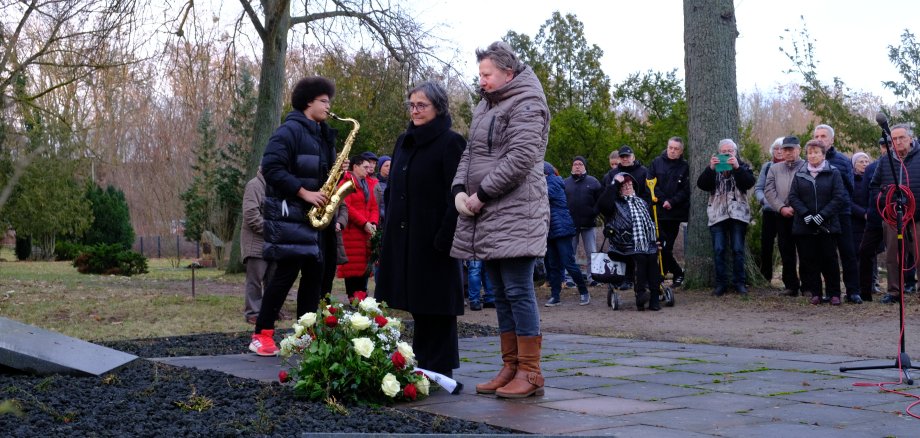
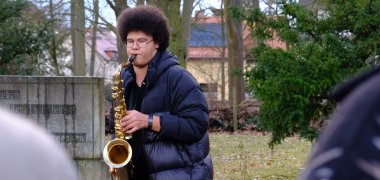
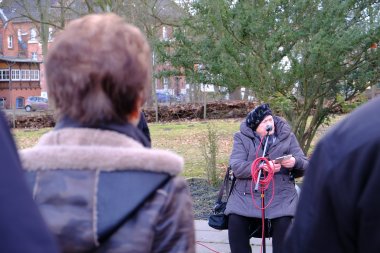
On 27 January 2025, around 50 people gathered at the Rüdersdorf Settlers’ Cemetery to commemorate the victims of National Socialism. Accompanied by Ilya Ananyin on the saxophone, the memorial service began with a speech by Renate Radoy, herself an eyewitness to that era. She described her experiences at the end of the Second World War and made it clear that far too often, people had remained silent. That is precisely why, according to Renate Radoy, remembrance is so important, a point she underlined with the poem “Against Forgetting”:
Against forgetting
by Karl Retzler
No, you’re not to blame for what your parents, grandparents, relatives and acquaintances have done.
But you will be complicit if it happens again!
No, you are not to blame for what happened,
, when you were a child or for what happened before you were born.
Yes, you’ll be complicit,
if it happens again!
You make yourself an accomplice if you allow
it to be trivialised!
You make yourself an accomplice if you allow
it to be forgotten!
You make yourself an accomplice if you allow it,
that people are once again being vilified, marginalised, persecuted or even killed because of their faith, their background, their sexual orientation,
or their physical, health or mental limitations
!
You are guilty if you follow the new Nazis,
downplay their actions, support them, or are even part of them!
Never again should anyone say: I didn’t know!
Never again should anyone say: I had no choice!
Never again should anyone say: what could I possibly have done about it?
Nobody needs and nobody wants a repeat of 1933–1945!
The choice is yours! You can see and hear!
And above all:
You can take action!
Let’s not forget!
Let’s not turn a blind eye!
Let’s not stand idly by!
This was followed by the
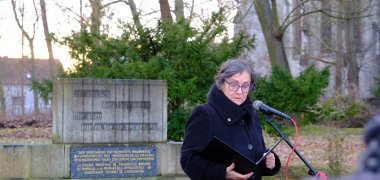
Speech by Mayor Sabine Löser
(the spoken word applies):
"Thank you very much, Renate Radoy.
Dear Sir or Madam,
and everyone present,
Remembering is a way of shaping the future. Eighty years ago today, the Auschwitz extermination camp was liberated by the Red Army. Over a period of five years, around 1.3 million people were deported to the Auschwitz concentration camp and its satellite camps.
1.1 million people were murdered there alone, including around 960,000 Jews. To this day, Auschwitz stands as a global symbol of the mass, systematic murder of Jews. Other victims included Roma and Sinti, Soviet prisoners of war, homosexuals, political opponents and many more. In short, anyone who did not fit into the Nazis’ inhuman worldview.
1.1 million people between 20 May 1940 and 27 January 1945. One has to try to imagine it – 1.1 million people, within 55 months. It remains difficult for us to comprehend, if only the sheer number. But also the fates behind it, the relatives, the suffering of those who survived.
After the liberation, the Soviet soldiers spoke of the living dead they had found there.
If, 80 years on, elected representatives – including those at federal and state level – are making racist, anti-Semitic or Holocaust-denying statements without a shred of shame, then we are exactly at the point that Renate Radoy highlighted in her poetry recital:
“Never again shall anyone say: ‘I didn’t know.’”
“Never again shall anyone say: ‘I had no choice.’”
“Never again shall anyone say: ‘What could I possibly have done about it?’”
We all know where hatred and incitement lead. Slander, denunciation and denial are easier than ever to spread and reproduce today.
In her speech at the memorial service for the victims of National Socialism in the German Bundestag, Rozette Kats, who was born in Amsterdam in 1942 to Jewish parents, said:
“Today I am 80 years old. I have not forgotten how terrible it is to have to deny one’s identity and go into hiding. There is only one answer to that: every person who was persecuted back then deserves to be remembered with respect. Every person who is persecuted today is entitled to our recognition and our protection!”
And one more thing: “My wish for our children, and for all the children of the world, is that no form of discrimination – and, in extreme cases, wars too, wherever they may occur – should be seen as normal, but rather as terrible aberrations that must be overcome!”
In a world that is becoming increasingly polarised, where we rarely allow the truth to last longer than a tweet, we must learn to listen again. To listen to one another. But also to tolerate dissent.
When I hear and read today that we have to fight for freedom of expression, it amounts to the active distortion of history and, ultimately, to schadenfreude at the expense of the victims of National Socialism. In our liberal democracy, one is free to say anything, provided one remains within the bounds of the Basic Law. But one must also be able to tolerate dissent. That is precisely what distinguishes us from autocratic regimes – we can argue, we can express opinions, we can disagree.
And that is precisely why I believe it is so important that we remember and listen – because only by understanding where hatred and incitement, exclusion and nationalism lead can we realise that we are complicit if it happens again.
Ladies and gentlemen,
we live in a stable democracy; we live in a cosmopolitan Europe. Eighty years ago – a lifetime ago – Europe lay in ruins and an unimaginable atrocity came to an end. Let us commemorate the victims and, at the same time, recognise the treasure that our democratic system represents, a treasure that must be defended. The lesson of Auschwitz must be that Auschwitz must never happen again. And ‘never again’ is now!
"Thank you."