



The Brandenburg state government has amended the current regulations aimed at containing the coronavirus. Tiered rules have been introduced depending on infection rates. The regulations come into force today, 21 October 2020.
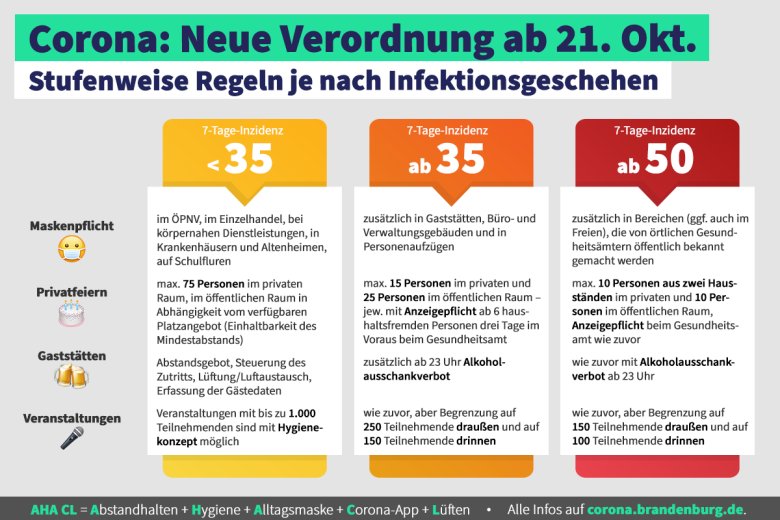
Excerpts from the state government’s press release of 21 October 2020:
"New coronavirus infections are rising dramatically across Germany. In Brandenburg, the current coronavirus figures are already at the level seen during the first wave in the spring. To keep the spread of infection under control and prevent a second widespread closure of nurseries, schools and business sectors, further infection control measures are now necessary. The Cabinet has therefore today – taking into account the decision of the Chancellor and the heads of government of the federal states of 14 October – supplemented the state-wide SARS-CoV-2 Regulation on Social Conduct with clear rules in light of the significantly rising infection figures.
This applies in particular to the number of participants at events and private gatherings, the serving of alcohol in restaurants and bars, as well as an extended mask mandate and contact restrictions in public spaces if the incidence rate exceeds 35 or 50 new infections per 100,000 inhabitants within seven days. The new rules are set to come into force as early as Wednesday, 21 October, and will remain in place until 30 November 2020.
With this amending regulation, Brandenburg is also lifting the ban on accommodation for guests from domestic German coronavirus risk areas. This complies with the decision of the Higher Administrative Court of Berlin-Brandenburg of 16 October. [...]
In Brandenburg, the number of laboratory-confirmed cases of COVID-19 has risen by 790 over the last seven days. Brandenburg’s 7-day incidence rate per 100,000 inhabitants currently stands at 31.3 across the state; a week ago, this figure was 17.8, and two weeks ago it was 9.7. The number of people currently infected with COVID-19 has more than doubled to over 1,220 within a week.
The daily figures published by the State Office for Occupational Safety, Consumer Protection and Health ( LAVG) on the website https://kkm.brandenburg.de/kkm/de/corona/fallzahlen-land-brandenburg/ and the publications of the relevant local authorities. This is a new feature of this amendment to the Social Distancing Regulations; previously, reference was always made to the publications of the Robert Koch Institute. However, due to the reporting process, the data is displayed there with a delay.
Important: From the day on which it is announced that the relevant incidence threshold has been exceeded, the stricter rules will apply for at least ten days, regardless of whether the relevant incidence threshold (35 or 50) is exceeded continuously during that period.
Where the 7-day incidence rate exceeds 50, the following also applies: if the rise in infection figures does not come to a halt within 10 days at the latest, the affected district or independent city must issue a general order imposing further restrictions on social contact in public spaces.
As a general rule: keep your distance, follow hygiene guidelines, wear a face covering, and ensure proper ventilation
Keep your distance, follow hygiene guidelines, wear a face covering correctly, and ensure proper ventilation – these protective measures remain in force throughout the state of Brandenburg.
Simple hygiene rules help to reduce the risk of infection in everyday life. Everyone is therefore urged to follow the general hygiene rules and recommendations issued by the Robert Koch Institute and the Federal Centre for Health Education to prevent infections (https://www.infektionsschutz.de/coronavirus/everyday-life-during-the-coronavirus-pandemic/follow-hygiene-rules.html).
A minimum distance of 1.5 metres must generally be maintained between people in both public and private settings. Exceptions apply, for example, to spouses or partners, members of the same household, and in the context of childcare and youth work. Exceptions also apply between pupils, and between pupils and teachers.
Everyone aged six and over must wear a face covering in places such as shops, when receiving personal care services (e.g. at the hairdresser’s), when visiting hospitals and care homes, when using local public transport, on coach trips, city sightseeing tours and similar tourist activities in enclosed indoor spaces, in airports, in the indoor areas of schools outside of lessons and other educational activities, as well as in after-school care facilities outside of childcare and educational activities taking place in group, exercise and other educational rooms, and in cinemas, theatres and similar cultural venues.
Exempt from the requirement to wear a face covering are , for example, deaf and hard-of-hearing people, and individuals for whom the use of a face covering is impossible or unreasonable due to a disability or for health reasons (this must be proven by a medical certificate), as well as staff in retail outlets where there is no direct contact with customers or where the spread of transmissible droplet particles is effectively reduced by suitable technical measures.
Gatherings and events: Organisers must ensure compliance with social distancing and hygiene rules. This means that at all public and private events, access and the number of people present must be managed and restricted so that social distancing requirements can be met in line with the available space.
In enclosed spaces, the following also applies: the indoor air must be regularly replaced with fresh air (in particular by opening windows briefly or by operating ventilation systems that draw in a high proportion of outside air; where recirculation of indoor air in ventilation systems is unavoidable for technical or technological reasons, these systems must be equipped with suitable filtration to remove airborne viruses). In addition, personal data must be recorded for the purposes of contact tracing. Anyone who fails to enter their personal details completely and truthfully in coronavirus contact lists faces a fine of between 50 and 250 euros.
Private gatherings: a maximum of 75 guests may be present at any one time in a private home. Important: as with all other events, the specific social distancing and hygiene rules must be observed here too.
Private celebrations include, for example, birthday parties, weddings, anniversaries, funerals and christenings. In other words, any celebrations that take place in a private setting amongst family and friends. Important: The term ‘private celebrations’ should be interpreted broadly, as situations may arise in which people no longer adhere to social distancing and hygiene measures as strictly as is required. In other words: a club meeting is not a private celebration; however, the social gathering that follows once the ‘work’ is done is. A company Christmas party is generally not a private celebration. However, if only a small group of colleagues meet outside working hours, then that is considered private.
Restaurants and similar establishments: Up to six people may sit at a table without having to maintain a minimum distance of 1.5 metres.
Cinemas, theatres, concert halls and similar cultural venues: The minimum distance between seats may be reduced from 1.5 metres to up to 1.0 metre, provided this is exceptionally permitted under a relevant hygiene framework and the distancing and hygiene rules specified therein are observed (https://mwfk.brandenburg.de/sixcms/media.php/9/Hygienerahmenkonzept_f%C3%BCr_Kinos_und_Kultureinrichtungen.pdf).
Large-scale events such as concerts, trade fairs or folk festivals: a maximum of 1,000 guests present at any one time. Condition: Organisers must draw up a hygiene plan and, on this basis, ensure compliance with social distancing and hygiene rules (this is regulated by the Large-Scale Events Prohibition Ordinance).
Major sporting events: Where the number of guests exceeds 1,000, 20 per cent of the venue’s regular total visitor capacity is permitted. This applies to venues with a capacity of 5,000 or more. Condition: Organisers must draw up a hygiene plan and, on this basis, ensure compliance with strict social distancing and hygiene rules (regulated by the Large-Scale Events Prohibition Ordinance and valid until 15 November 2020).
Discos, clubs and similar venues must remain closed to the public for infection control reasons.
The same applies to brothels, swingers’ clubs and similar establishments. Only erotic massages that do not involve sexual intercourse are permitted, as they, like other personal care services, carry a lower risk of infection.
Steam saunas, steam baths and similar facilities remain closed due to the higher risk of infection. However, dry saunas with temperatures above 80 °C and without water being poured over the stones are permitted.
Indoor contact sports are permitted subject to certain conditions: fixed groups of no more than 30 people for team sports and no more than 5 people for individual sports may train in sports halls and other enclosed spaces. For competitions in sports where it is impossible to comply with social distancing rules whilst practising the sport, a maximum of 100 people (competitors and officials) may be present at the same time during competitions held in enclosed spaces. However: The exemption from the general social distancing rule applies only to the actual practice of sport.
This applies when the 7-day incidence rate exceeds 35
If the threshold of 35 new infections per 100,000 inhabitants is exceeded in a district or an independent city within the last seven days, the following additional measures apply there under the amended Coronavirus Measures Ordinance the following shall also apply:
Events: a maximum of 250 guests at any one time outdoors or 150 indoors.
Important: “In this case, the Social Contact Regulations apply, not the Large-Scale Events Regulations!”
Private gatherings: a maximum of 15 people in private homes or a maximum of 25 people in public or hired venues
Important: Organisers must notify the relevant public health authority at least three working days in advance of any private gatherings with more than six guests from outside their own household present at the same time, stating the venue and the planned number of attendees. This applies to private parties held in private homes as well as in rented premises. Private parties do not require a licence.
Ban on serving alcohol: Restaurants, pubs and bars are not permitted to serve alcohol between 11 pm and 6 am.
Face coverings are required:
- in restaurants and pubs for staff in contact with customers, as well as for customers who are not seated at their designated tables; this also applies to private functions held in restaurants or other premises hired for celebrations,
- in office and administrative buildings for staff and visitors, provided they are not at a fixed workstation and the minimum distance of 1.5 metres cannot be reliably maintained,
- for users of passenger lifts,
- NEW: in all areas where people gather in large numbers or for extended periods on public paths, roads and squares (e.g. pedestrian zones) – this must be ordered by the district authority or the independent city by means of a general order
This applies when the 7-day incidence rate exceeds 50
If the critical threshold of 50 new infections per 100,000 inhabitants over the past seven days is exceeded in a district or a city not belonging to a district, the following additional measures apply there under the Coronavirus Management Ordinance the following shall also apply:
Events: a maximum of 150 guests at any one time outdoors or 100 indoors
Private gatherings are prohibited in private homes and on the associated private property if more than ten people from more than two households are present at the same time, or in public and rented premises if more than ten people are present at the same time.
Social distancing rules in public spaces: a maximum of 10 people or one household;
Should the 7-day incidence rate exceed the 50 mark for at least 10 consecutive days: a maximum of 5 people or one household – this must be ordered by the district or independent city by means of a general ruling.